

Latest album · Solo Musica · December 2025
Schubert
Six Moments musicaux D 780 · Four Impromptus D 899 · Hungarian Melody D 817
Utmisol…a real talent that bathes Schubert’s scores in brilliant light
Marc Laborde · 17 March 2026
Jean-Nicolas Diatkine offers us a CD devoted entirely to Schubert, a delicate, subtle composer. The pages recorded here are as demanding as they are seemingly simple, even immediate.
Our performer approaches this music with humility. Like a waking dream, these pages plunge us into reveries – Andantino – that are like a praise of slowness. In the Six Moments musicaux, time seems suspended and the pianist’s sensitivity is infinite.
We find these qualities again in the Impromptus, of a dark elegance but also of flawless virtuosity.
The Hungarian Melody combines power and liveliness.
In this recording Jean-Nicolas Diatkine shows a real talent that bathes Schubert’s scores in brilliant light.
A most delicate recording.
Crescendo MagazineSchubert by Jean-Nicolas Diatkine, an invitation to an imaginary world
Jean Lacroix · 1 March 2026Performance 10/10
Sound: 9 · Booklet: 10 · Repertoire: 10 · Performance: 10
When he decided to embark on a solo career in 1999, the Parisian pianist Jean-Nicolas Diatkine (b. 1964), who had studied with disciples and pupils of Claudio Arrau, including Ruth Nye (b. 1932) in London, was also accompanying singers such as the Argentine soprano Alicia Nafé (b. 1947) or the Ghent tenor Zeger Vandersteene (b. 1940), with whom he left recordings of songs by Duparc and Bizet in the early 2000s, in the Gents Muzikaal Archief series. Crescendo’s columns have warmly welcomed his solo programmes released by Solo Musica: Liszt’s transcriptions of Schubert and Wagner (2022), Chopin (2023), and a live recital devoted to Beethoven, Liszt and Liszt/Wagner (2024).
This time he devotes himself to Schubert alone – Schubert whose invitation, as he writes in a copious booklet note of his own, is to enter an intoxicating imaginary world whose fragrance is so powerful that listener and performer alike can only surrender to the dream they feel being born within them, spellbound to the point of momentarily losing all sense of reality.
Accompanying singers, including Zeger Vandersteene, to whom he pays tribute for advice drawn from his intimate knowledge of the Schubert Lied, has enabled Diatkine to develop a refined playing that flows naturally, both poetic and lyrical, yet full of nuance and sincerity.
One is convinced of this from the Six Moments musicaux, composed from 1823 and published in 1828 in two books of three pieces each. These pages, extremely well known and rightly celebrated, have awakened in Diatkine what he calls listening paths […] using metaphors, which we leave the listener to discover in his text. We note the richness of the playing the pianist deploys along the way, combining sensitive singing with the images unfolding under his fingers. We endorse the tenderness that pervades the first ‘moment’, the fluid barcarolle rhythm of the second, or the graceful dance of the third, in which Diatkine says he could see, in its brevity, the monologue of a horse describing its life in harness in Vienna in 1823, proud of its coat and snorting under its plumes and bells. The image is appealing; it evokes what time spent with Schubert stirs in the soloist’s imagination.
The fourth Moment musical offers a world whose central episode recalls that of the nineteenth song of Winterreise. His familiarity with singing ideally serves this page with its tormented accents. In the fifth, where, Diatkine declares, the piano becomes an orchestra, we are plunged into a passionate atmosphere. The sixth, a pure gem, combines the composer’s modesty with his pain, but also with a light that hides many secrets. From all the feelings that run through these Moments musicaux, Diatkine creates a bouquet of emotions that touch us to the heart.
The four Impromptus D 899, composed in the summer and autumn of 1827, confirm the soloist’s affinity with Schubert’s world. He is at ease in the first, in which he sees a song without words evoking the same atmosphere of tragic heroism as Heine’s The Two Grenadiers. In the second, charm and freshness dominate, with brilliant touches. The third, one of the high points of the programme, unfolds amid almost magical outpourings, like a quivering nocturne. The fourth, which shares the virtuosity of the second, with cascades of chords and expressive contrasts, proves ardent. A real overall success.
The programme ends with the Hungarian Melody D 817, said to have been inspired when Schubert, during a stay in Hungary, heard a servant girl singing. A charm imbued with simplicity, closing this truly fascinating recital.
MuzikzenA colourful and meditative Schubert with Jean-Nicolas Diatkine
Olivier Brunel · 27 February 2026
The French pianist Jean-Nicolas Diatkine’s approach to Schubert’s piano music is rather meditative. He explains it at length in the fascinating trilingual booklet: he had approached Schubert on a previous recording from the Lied side, through Franz Liszt’s transcriptions.
[…]
The much-loved Impromptus op. 90 D. 899 benefit from an impeccable technique: a beautiful serenity and often twilight colours that suit this frequently tragic music well. As for the Hungarian Melody D. 817 that closes the recital – developed at length in the four-hand Divertissement à la hongroise D. 818 – no one will match the wonderful Mitteleuropa spirit lavished by András Schiff (Decca). Jean-Nicolas Diatkine breathes into it a spirit by turns colourful and meditative, in keeping with the whole of this precious recital.
Weser KurierOne never tires of listening to this sensitive and seasoned master
I. Hetscher, A. Knief and S. Loskant · 30 January 2026
“Schubert, together with Beethoven, is one of the composers who are essential to my life,” says the Parisian pianist Jean-Nicolas Diatkine – and it shows on his CD of piano works. The 61-year-old pianist immerses himself with serene clarity in the six Moments musicaux and the first set of four Impromptus, familiar to amateur pianists from their piano lessons. He sometimes uses so little pedal that, for example, the accompaniment of the second Moment musical sounds almost gaunt. The point is to evoke a “lump in the throat”, Diatkine explains in the booklet, where he sets out his ideas. In the following piece he evokes the trot of a Viennese cab horse; in the one after, he recalls the song “Täuschung” (Illusion) from Schubert’s Winterreise, and so on. Diatkine’s analytical rigour brings these works closer to Beethoven, a perspective that suits them very well. The encore, the Hungarian Melody, surprises with its very free, klezmer-like tempo fluctuations. One never tires of listening to this sensitive and seasoned master.
France Musique · En pistesA singular personality
Émilie Munera and Rodolphe Bruneau-Boulmier · 16 January 2026
Transcript of the programme “En pistes”
– “You know, sometimes an artist’s career is something mysterious…
– Yes…
– We don’t know what makes a career succeed, and we have artists we know less well and discover after a while, who have other kinds of careers…
– A second career?
– …or who have careers far from the big stages; or always, too, in places: who are attached to places, and that is the case of Jean-Nicolas Diatkine.
– Ah, but I’ve already heard this musician!
– You’ve already played one of his records…
– Yes, absolutely.
– I think it was a Beethoven or Schubert or Chopin record. Because Beethoven, Schubert and Chopin are rather the pillars of his repertoire. Since 2011 he has performed every year at the Salle Gaveau in Paris. It’s true that otherwise Jean-Nicolas Diatkine’s career doesn’t invade either the concert halls or the record shops… and yet he is a pianist who plays very beautiful works, and plays them very well!
And you’re going to hear him here: he has recorded a Schubert album, with an impromptu; this is Jean-Nicolas Diatkine…
And go and look at this pianist’s biography and interviews – he is a singular personality!
ON-MAGJean-Nicolas Diatkine’s inspired Schubert
Jean-Pierre Robert · 6 January 2026Technical rating 5/5
Jean-Nicolas Diatkine devotes his new album entirely to Schubert. An immersion that amounts to “an invitation to enter an intoxicating imaginary world, whose fragrance is so powerful that listener and performer alike can only surrender to the dream they feel being born within them,” he stresses. The Moments musicaux and Impromptus are its revealers here.
Not content with playing them, the pianist comments on the two chosen cycles with relevance and vivid imagery. The Six Moments musicaux D 780, from 1823–1824, form a remarkably coherent whole across their two books. The first, Moderato, perhaps the least easy, “a dream within a dream”, is a kind of scherzo in which one senses how Jean-Nicolas Diatkine’s playing, refusing showy virtuosity, is all clarity, attentive to accentuation and to the different moods Schubert distils. The Andantino that follows plunges, through its episodic rondo, into a world of gravity that borders on the tragic in its middle section, while pouring out tenderly. A sort of dance recalling the end of the Rosamunde ballet, the Andante moderato moves along joyfully here, like “the monologue of a horse describing its life harnessed to a cab in Vienna in 1823”. The fourth piece, Moderato, returns to a dark and serious register, first in a fluid tempo, a kind of perpetual motion, then, after one of those sudden breaks of which Schubert has the secret, in a dance rhythm. From tears to joy, as it were, as in Mozart. In the following Allegro vivace, close to the Écossaise type, Diatkine marks the rhythmic pulse of what is once again “a dance movement of explosive vehemence”. Finally, the Allegretto, known as the “Troubadour’s Lament”, breathes “a painful feeling in the chords repeated twice like a cry of distress”, while the central section, by contrast, “has the peaceful, reassuring character of a religious revelation”.
Of the Four Impromptus D 899 (1827, the first cycle of a set of two), it has been said that they could represent the various movements of a vast sonata. They highlight the theme of the wandering traveller, the Schubertian Wanderer, and breathe an often heightened expressiveness. The Allegro molto moderato is built on a resolute march theme that is explored in variations, so many different lights, several of which recall the songs of the contemporary Winterreise cycle. Diatkine sees in it “the scenario of a song without words evoking the same atmosphere of tragic heroism as Heine’s The Two Grenadiers”. His interpretation is striking for its work on the almost obsessive metamorphoses of the theme and its use of insistent pedal. As in the following Allegro, fluid like flowing water, lithely following the rhythm, which asserts itself in the middle section but without violence. The literal return of the theme becomes more insistent, up to the final prestissimo. In the third piece, Andante, the expressive, continuous theme takes on the “contemplative calm” Brigitte Massin sees in it. Like the first, this Impromptu unfolds multiple lights. The Allegretto concludes this admirable cycle through wondrous transitions, moving from apparent insouciance to barely contained drama. And always those lyrical flights that belong to Schubert alone, to which Diatkine holds all the keys and whose benefits he distils.
As an encore he offers the Hungarian Melody D 817 (1824), emphasising its Magyar side, close, he says, to the klezmer style – he could well imagine it played on the clarinet, the traditional instrument of that culture! Indeed, one admires the play of marked accents, again illustrating the theme’s various transformations, pushing the tempo when needed.
Recorded at the Teldex Studio in Berlin, the Steinway grand displays all its panache, in an airy sound image of real depth.
Technical rating: (5/5)
Dariusz Marciniszyn · FacebookAn entirely new look at Schubert’s piano music
Former editor of Ruch Muzyczny · 31 December 2025
Dariusz Marciniszyn, former editor of the Polish magazine Ruch Muzyczny (“The Musical Movement”). Published on Facebook.
As usual, the end of the year is an opportunity to take brief stock of the past twelve months’ pianistic achievements. This time, however, I will focus exclusively on recordings. Why? There is one indisputable recording I could cite immediately, but that would mean returning to the subject of the Chopin Competition and its accompanying eliminations and qualifications, about whose honesty I have 100% doubts. So I decided to mention only commercial releases. In theory I should draw up a long list of discs or offer a personal ranking of the recordings that impressed me most. However, since one disc clearly surpasses (in my opinion) all the others released this year, I will focus solely on presenting this album.
Jean-Nicolas Diatkine has impressed me several times in recent years, as I said publicly almost two years ago in the pages of Ruch Muzyczny. This time the French pianist has decided to record a series of works by Franz Schubert: the Impromptus D 899, Moments musicaux D 780 and the Hungarian Melody D 817. As usual, Diatkine surprises with his extremely perceptive approach to the masterpieces presented. I was particularly won over by his interpretation of the Moments musicaux, full of articulatory nuance – all the more so as the echoes of my enthusiasm for Ivo Pogorelich’s concert readings in 2023 still resonate in my memory. Jean-Nicolas Diatkine is an artist whose proposals always depart somewhat from so-called canonical recordings, yet he is not a revolutionary pianist.
I highly recommend this recording, because it offers an entirely new look at Schubert’s piano music.
I would very much like to hear this artist in Warsaw or at the National Forum of Music in Wrocław. Perhaps it will happen one day…
ClassiquenewsA vision of exceptional depth…
Alexandre Pham · 22 December 2025
The pianist Jean-Nicolas Diatkine gives us ‘his’ Schubert: a vision of exceptional depth, born of his intimate understanding of the Viennese composer’s inner landscapes. Imagination here is at its peak, the sovereign fire of a sensibility that seems to understand Schubert, his evocations and personal deliriums, which would thus be the fruit of a kind of sleepwalking or clairvoyance peculiar to the composer, as if seized, in a trance when composing, as many of his friends and witnesses attested.
In practice, the pianism flows naturally with the acuity of a preserved sincerity that itself imagines a whole world of feelings, combining seduction, secret understanding, ardent desire and nostalgia for a dream that may never have existed, but to which the sound itself gives body: it is the pianist’s gift to express what lies between known worlds; he sings a sonic ideal in which all the most personal aspirations crystallise – ardent exaltation, intimate jubilation, and also bitter, grave burns.
This modest, visceral playing unfolds, notably in the immense 6 Moments musicaux D 780 (1823–1824), a wealth of nuance that only the greatest diseurs in the twin genre of the Lied can master; here every bar, its tiniest nuances revealed, carries its own story, its deepest dreams, its existential quest… (Andantino), broken by the free, intoxicated song of the Allegretto moderato, whose secondary, more anxious and nostalgic fields Jean-Nicolas Diatkine knows how to express.
The radicalism and vertigo born of the powerful consciousness of the sixth and last Moment, ‘Allegretto’, place Schubert alongside his model in Vienna, the unattainable Beethoven, whose demiurgic force of musical thought he shares: here the composer calmly confronts death itself, now experienced as a serene experience, a release that transcends the incarnate being by allowing him to envisage his celestial, abstract transformation.
The pianist approaches the 4 Impromptus by expressing their unbreakable organic bond, as if they were the 4 movements of one and the same sonata. Ultimate bareness and intimate depth thus inspire equally masterful playing throughout the 4 episodes of D 899: the pianist makes the keyboard sing with a sincerity both grave and tender; he is on familiar ground, expressing a personal, direct song (the dancing fluidity, the liquid, refreshing outpouring of the Allegro); whether it is the questioning of a grenadier faced with death and the violence of war (as the performer suggests, quoting Heine), the expressive truth places Schubert in the realm of brilliance and truth. The Andante remains the most overwhelming passage, like the confession of an infinite tenderness whose insouciance and intoxicated candour Jean-Nicolas Diatkine expresses.
Crackling and of preserved modesty, remarkably articulated, the Hungarian – not to say Gypsy – Melody (1824) concludes this remarkable programme; its song moves by its intense simplicity and sincere truth: no doubt about it, Jean-Nicolas Diatkine is a Schubertian both refined and profound; he plays Schubert like a native language and his invitation raises no reservations; never has Schubert sounded or sung with more humanity, truth and authentic sincerity. This is surely the CD everyone has one day dreamed of hearing… masterful in its simple power.
OrchestergrabenA recording that leaves a lasting impression
Stefan Pieper · 17 December 2025
Jean-Nicolas Diatkine plays Schubert. Franz Schubert’s piano miniatures must prove their timelessness to each new generation. The Moments musicaux, the Impromptus – they sound familiar, almost too familiar. All the more remarkable, then, when a pianist makes this music sound as if one were hearing it for the first time. On his new recording for the Solo Musica label, Jean-Nicolas Diatkine succeeds in bringing a subjective artistic perspective that reveals afresh the universal message of this music.
A personal approach to Schubert’s piano miniatures
This recording has a personal story. Diatkine’s mother, a doctor, had helped him learn these pieces as a child. He worked on the recording for a year – not to repeat what he already knew, but to rediscover it. Shortly before her death, he was able to let her hear the finished CD.
Rhetoric, sound and narrative power in Jean-Nicolas Diatkine
The French pianist never attended a conservatoire. His school was accompanying Lieder: Winterreise, Die schöne Müllerin, Schwanengesang. You notice it immediately. His rhetoric is eloquent: staccatos that explore nearness and distance, crescendos that swell and fade, pauses that say more than many a fortissimo. In the Moments musicaux one feels an intact creative force from the very start. In the first piece, hemiolas create an underlying tension. The second begins in five voices – the voices seem driven by an inexhaustible breath. In the third, I hear the onomatopoeic rhythm of a trotting horse – a miniature of barely two minutes to which Diatkine lends surprising depth through precise accentuation.
In the fourth Moment musical, one notices how Diatkine highlights the contrast between the dark C sharp minor and a dancing episode in the major: the latter seems to come from very far away and, in retrospect, makes fate all the more tragic. The fifth piece seems to have been conceived for orchestra – the leaps sound not like pianistic gestures but like changes of instrument. The sixth is all the more convincing as a haven of peace. With the Impromptus the character changes radically. In the first, Diatkine projects the isolated dissonant chord, lets the overtones die away, continues in a muffled staccato. The martial character gets into your limbs. Then comes the transformation: the legato flows, the melody gains space. One is amazed at how he sustains the arc, how nothing collapses.
Impromptus, Hungarian Melody and a lasting impression
In the second piece, cascades of notes follow one another at top speed – an imaginary wind blows through the figurations. Diatkine plays the broken chords so that the melody remains audible in the upper voice. This is music lived down to the last nerve cell. In the third, the accompaniment floats inarticulately while the melody unfolds like a ballad. In the fourth, arpeggiated figures meet powerful chordal replies – Mediterranean lightness and dramatic seriousness in constant dialogue. The Hungarian Melody surprises. At first one wonders why Schubert called it a melody when it sounds like a march. Diatkine gives the answer: he plays with free rubato, with accelerations and halts. It becomes a dance that makes room for lament, for storytelling. The ‘Hungarian’ label was probably camouflage at the time – it was not socially acceptable to call a melody ‘Jewish’ or ‘Gypsy’. Diatkine doesn’t turn it into an academic discourse. He plays.
What remains after listening? The impression of a pianist who, in his own words, ‘disappears’ to make the music visible. Transparent, clear-sighted and entirely at the service of what Schubert might have wanted to say.
A recording that leaves a lasting impression.
Thierry VagneAnother success
17 December 2025
Diatkine’s Schubert is rather dark, meditative – more Winterreise than Schöne Müllerin. Given the level of his performances, I did not hesitate to compare them with those of illustrious pianists, such as the Moments musicaux by Clifford Curzon (1971), little known in France: his tempi are almost all faster than Diatkine’s, who plays No. 2 (Andantino) in 9’48 against 6’37 for Curzon! One suspects that what is lost in lightness is gained in inwardness. A matter of taste, but Jean-Nicolas Diatkine never lets go of the listener, who is obliged to tread the “snow” with him!
For the first set of Impromptus, I went back to Radu Lupu in his prime (1983 – sadly I was only able to hear him in concert at the end of his life). This time no notable differences in tempi – one appreciates the usual quality of Jean-Nicolas Diatkine’s playing, the freedom of the voices, the continuity of discourse so essential in Schubert’s piano music. I particularly recommend the first Impromptu, which becomes almost breathless: a superb commitment that tends to suggest that the Romanian’s interpretation leans a little towards the “pretty”.
As a complement, a very beautiful, curiously dreamy Hungarian Melody.
Another success.
PizzicatoSchubert, lonely and embittered
Remy Franck · 14 December 2025
In the Moments musicaux, Jean-Nicolas Diatkine shows us a lonely and embittered Schubert who bares his soul. The cracks, fractures and harshness of these spiritual constructions are all the more evident as the tempos are calm. Diatkine surrenders to the music, not sentimentally, but by immersing himself meditatively in its deep musical language. In the Moments musicaux this leads to very personal interpretations, inspired by the image of a desperate Schubert with no way out. Even the first set of Impromptus D. 899 becomes a profound psychological drama. The simple, sober beauty of this music is not neglected, but it only heightens the contrasts, for Diatkine finds more dramatic flashes in Schubert than other pianists do. Not everyone will necessarily appreciate this, since beauty, lyricism and charm are perhaps neglected. But, as we said, that is not what Diatkine is looking for in Schubert.
His analytical and profound recording is a good alternative to more romantic interpretations.
In his own words
Interviews & portraits
Pianist Magazin · Ritmo · Pizzicato · Orchestergraben · Thierry Vagne
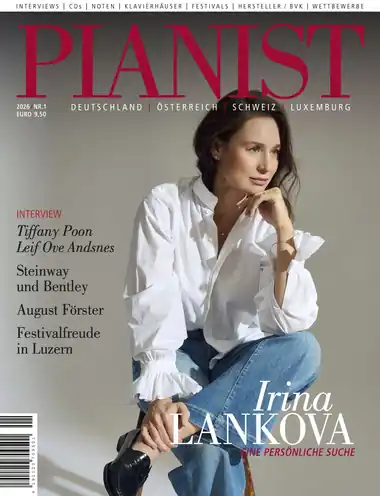 Pianist Magazin · Portrait
“It was with singers that I learned freedom”
Stephan Schwarz-Peters · April 2026
Jean-Nicolas Diatkine began playing the piano at the age of six – but it was only at 17 that he was able to devote himself entirely to music. Since then he has followed his own path: between lyricism and structure, between Buddhist presence and the craftsman’s seriousness of the performer.
Pianists’ careers can take very different paths. The most direct one probably leads from the nursery straight into the wide world of the international music industry, but from an artistic point of view it is often not the best. Still, concentrating on piano technique as early as possible has the advantage of making it relatively easy to acquire skills that, at a later age, can only be learned with difficulty – and certainly not as naturally. Although Jean-Nicolas Diatkine had already taken lessons at the age of six, it was only in his teens that he developed a real interest in the piano. “I always try to see my path as something positive,” recalls the Paris native.
“My teacher at the time regretted it a great deal and never stopped pointing out everything I had missed. But over time I learned to deal with it and even to see it as an advantage.” What helped this late starter, whose parents only allowed him to devote himself fully to music at 17, was meeting renowned teachers such as the composer Narcis Bonet, trained by Nadia Boulanger, and the pianist Ruth Nye, from the school of Claudio Arrau. “At the time I was very interested in Arrau, in his biography and his philosophy. He said that the real problem lies in the moment when, as a teenager, you start to become aware of what you are doing – at the piano and in music. As an adult, I had to relearn everything, fully consciously. And the hardest part was drawing on the bodily memories of my early childhood. I had to find that naturalness again.” Buddhism helped him in this; he discovered it through Carlindo Valeriani, another Arrau pupil, and has practised it for more than 40 years in the form of Nichiren Buddhism. “I understood that I had to stop wanting to understand everything and instead develop a broader awareness, something that connects mind and body instead of separating them,” Diatkine explains. “I had also realised at the time that I lacked empathy – that ability to be open to others – but it was in music that I discovered that attitude.”
Another distinctive feature of Jean-Nicolas Diatkine’s artistic path is his strong orientation towards vocal music. One is tempted to see him as Chopin’s last pupil – Chopin who, as we know, advised all his students to go to the opera as often as possible to learn from the technique and the art of vocal illusion of singers. As a coach at a singing school, Diatkine spent more than ten years, from 1996 to 2006, studying in depth every day the links between voice, body, mind and piano playing. It was there that he learned a great deal about legato playing, including some surprising things: “Chopin said you had to listen to singers to find that continuous line. But when I worked with singers myself, I had to admit that many of them didn’t even know what legato was. That’s when I understood: legato is not a physical problem. It’s a concept. If you read a phrase correctly, if you really understand it, then the music flows naturally. Everything depends on the tiniest details.”
Diatkine’s sublime art and mastery of sound production are amply documented on the many recordings the pianist has made for the renowned independent label Solo Musica. His latest releases include piano works by Schubert (2025), a recital recorded live at the Salle Gaveau in Paris (2024) and a set combining Chopin’s Third Piano Sonata and the 24 Preludes (2023) – a composer who holds as central a place in Diatkine’s repertoire as Ludwig van Beethoven. For him, Beethoven is the ideal mediator between melodic line and refined musical architecture. The fact that it is mainly connoisseurs rather than the general public who appreciate his pianistic gifts does not bother him in the least – he who performs not only in Paris, in major halls. Far more important to him than a full diary is the freedom he feels when making music. Besides his work with singers such as his regular partners Alicia Nafé and Zeger Vandersteene, it is also his Buddhist orientation that has helped him reach this freedom. “Locking singers into the straitjacket of a composition would never work, because they need to breathe,” says Diatkine. “That freedom of interpretation – saying: ‘I do it this way or that way, because I need to breathe’ – is really what I learned from singers.”
The pianist has often noticed that not only performers but also audiences are frequently under a certain pressure. “On my first tour of Japan in 2017, I met an audience that was absolutely focused and completely absorbed in the music,” he recalls. “In France it’s different: many people go to concerts because others do, then they sit there afraid of not understanding anything. That’s why today I always give short introductions before my concerts, to take away that pressure.” The plans Jean-Nicolas Diatkine is currently working on are very concrete: “I have long intended to record Chopin’s Études. In two or three years I would also like to make recordings with an orchestra. My dream would be Beethoven’s Fifth Piano Concerto – it’s a promise I made to my father.”
Stephan Schwarz-Peters
Ritmo · EntretienSchubert at his most tragic and most lyrical
Blanca Gallego · April 2026
After a highly acclaimed recording of Chopin’s music, pianist Jean-Nicolas Diatkine returns with a new piano album on Solo Musica, this time devoted to the works of Franz Schubert, a choice made “for personal reasons: I wanted to pay tribute to my mother, who particularly loved Schubert. It was thanks to her encouragement that I played my first Schubert Moment musical as a child. She died at the age of 102, three days after listening to the album as soon as it came out, as if she had been waiting for it.”
Welcome back to RITMO, maestro, this time with Schubert after your Chopin album. Why did you choose this Schubert? And why Schubert?
For personal reasons: I wanted to pay tribute to my mother, who particularly loved Schubert. It was thanks to her encouragement that I played my first Schubert Moment musical as a child. She died at the age of 102, three days after listening to the album as soon as it came out, as if she had been waiting for it.
We are truly sorry, maestro… You include the Impromptus D 899 on the album, but not the Impromptus D 935… Do these cycles have anything in common other than their name?
I had already recorded the Impromptus D 935 (op. 142) in 2016 at the Teldex Studio in Berlin. I chose Teldex because the sound recording there is reminiscent of 1970s vinyl records. It emphasises not so much brilliance as a very wide palette of colours, which is very important for Schubert’s music. That is why I chose this studio again to complete the series of impromptus with D 899 (op. 90), with the aim of bringing them all together in the future. Each of the two cycles of Impromptus can be seen as a sonata in four movements; their publication as separate pieces is explained by the constant criticism publishers levelled at Schubert: they often found his works too long and therefore hard to sell.
How do you approach Schubert’s music: from the angle of tragedy and suffering, or through the melodic, cantabile vision of a composer who died at only 32?
In Schubert’s work, the tragic and the lyrical are intimately linked. A contemporary and great admirer of Beethoven, he was only ‘discovered’ after his death by Romantic composers such as Liszt and Brahms. As a result, the interpretation of his music was probably influenced by a tendency towards expressive exaggeration common at the time. My work on these pieces gradually led me towards a more sober vision that reinforces their dramatic character.
What are the main differences between the Impromptus D 899 and the Moments musicaux D 780, which you have also included on this recording?
To characterise Bach and Beethoven, Wilhelm Furtwängler used the words ‘being’ and ‘becoming’ respectively. These terms apply just as much to the Moments musicaux and the Impromptus. The Moments musicaux describe states that differ considerably in sound and dramatic scope: for example, the meditative, almost motionless Second contrasts sharply with the Fifth, where the intensity seems greater because it is so short. The Impromptus share a powerful momentum that runs its course, overcoming every obstacle.
Does the Hungarian Melody D 817, with Schubert’s usual melodic structure so characteristic of his Lieder, serve as an encore to close the disc?
The Hungarian Melody is probably inspired by klezmer, with great rhythmic freedom. In Schubert’s version for piano four hands, the Divertissement à la hongroise D 818, certain tempo markings leave no doubt about this. It seemed illuminating to me to end the album by illustrating his open-mindedness in this way.
Pizzicato · EntretienInterview with Jean-Nicolas Diatkine: “You cannot steer Schubert”
Stefan Pieper · 18 December 2025
A conversation with French pianist Jean-Nicolas Diatkine about his new Schubert recording, the secret of rubato and a last gift to his mother
Jean-Nicolas Diatkine is one of those pianists waiting to be discovered. This Frenchman, who never attended a conservatoire and whose musical style is rooted in Lied accompaniment, presents with his new Schubert recording an album that captivates through its humanist depth and subjective artistic perspective. Four years after our conversation about his Chopin recording, I meet him again on the occasion of an album that is much more than a recording: a farewell gift to his 102-year-old mother, three days before her death.
Four years have passed since our last conversation. What has changed in that time?
A great deal. Personally and professionally. This Schubert recording has a very personal origin: my mother loved these pieces. She lived to 102 and I knew she would soon leave us. So I wanted to give her this recording. A month before her death, I was able to play her the CD. She listened to it from beginning to end, for more than an hour, without saying it was too long. She even hummed along, because she understood everything. I had learned some of these pieces with her when I was nine. She was a doctor, not a musician, but she played the piano and helped me practise. When she heard the recording, she was satisfied. Three days later, she passed away.
What did that moment mean to you?
It was like a gift. My mother helped me close the circle. My career has had many difficulties and detours. Being able to show her what I had become before she left was like a proof. I now feel a coherence between the beginning and the end. But I also had to reinterpret this music in a completely new way. With Schubert, you can’t play the way you played before. You always have to rediscover him in the present, and sometimes change something too.
You worked on this recording for a year. What was the starting point?
I was playing the pieces and suddenly noticed that something wasn’t right. My old conception no longer worked. I had to find something more precise, a clearer inner image. Schubert was a song composer – I believe he never thought without a poem, without a scenario. Unlike Beethoven, who built like an architect. With Schubert, I had to find the scenario. And when I found it, everything became clear.
Can you give an example?
The Hungarian Melody. At first I played it very evenly, like many pianists. But then I said to myself: this isn’t a melody, it’s a march. One-two, one-two. Why did Schubert call it a melody? And the phrases weren’t clear. Then I heard Prokofiev’s Overture on Hebrew Themes with clarinet – from the klezmer tradition. And I thought: this must be a clarinet, not a voice. That rhythm, that freedom, is what Schubert meant. I began to play with much more rubato, with accelerations and halts. It became a dance, not a march. I know some people find it too free. But I’m sure it’s right. Schubert was very interested in the music of the Roma, in their free rhythms. And the name ‘Hungarian’ was rather a camouflage at the time – as with Liszt’s rhapsodies. It wasn’t socially acceptable to call a melody ‘Jewish’ or ‘Gypsy’.
You write in the booklet that listening to Schubert means entering an imaginary world whose pull you cannot escape. What do you mean by that?
With some composers, you can steer the music as you wish. Not with Schubert. His vision is so strong that you have to let yourself be captivated. You follow him, not only as a melodist but also as a dreamer. I read that Sviatoslav Richter would repeat certain passages for hours when working on Schubert. Three hours on the same line. It sounds crazy, but it works. It’s like hypnosis. You enter the same world as Schubert.
How do you see your role as a performer in this system?
I have to disappear. I mustn’t play with my ego. I have to be completely transparent. On the other hand, every interpretation by every serious performer produces a unique result. Every person is different. It’s like light through different fabrics: the result is always different.
For years you accompanied singers in Schubert’s great cycles. How has that influenced your solo playing?
I learned to breathe. When you work with a singer, you have to breathe with them. You have to stop when they need time. That still influences my piano playing today. Another important experience was working with an Italian maestro who had learned Toscanini’s typical Rossini performance tradition. He taught me to guide a singer without saying anything, only through small accelerations and slowings, through breathing. It was an incredible experience.
You often speak of orchestral sounds in Schubert. What do you mean?
Schubert heard within himself many sounds that were not piano sounds. He tried to realise them on the piano. In the fifth Moment musical, for example, those leaps aren’t pianistic. They exist because another instrument is playing. It really is an orchestra. When I worked on it, I suddenly thought of Bruckner. The scherzo of the Ninth Symphony is very close. There are also those daring modulations, a new one every three or four bars. It’s frightening. Fantastic music.
On your recording, one notices how you turn the melody into song while the accompaniment creates a whole world.
That’s exactly what I try to do. In the third Impromptu, for example, I don’t play the accompaniment too slowly or with too pronounced an articulation, so that the melody can develop its own phrasing. My reference here is the opening of Beethoven’s Ninth Symphony in Furtwängler’s recording – those barely audible sextuplets that create an incredible lightness. The accompaniment must be like water. The melody spreads over it like a ballad. In the fourth Impromptu, on the other hand, everything is dance – you mustn’t play the broken chords too slowly, otherwise you no longer hear the melody in the upper voice. It’s a cascade, and the upper voice has a role in it.
What is the relationship between analysis and intuition for you?
The two come together when I play. For a long time I worked with a composer who had very precise analytical ideas. Even if I found this approach convincing, it often didn’t work physically, because the body has its own logic. It says: ‘No, I need to breathe, I need time for this gesture.’ The piano has its demands too. So you have to adapt. What was interesting was that when I played for him a week later he was satisfied, even though I thought I hadn’t done what he wanted. My brain had absorbed his idea and made it my own. Sometimes something works in the unconscious, like an automatic correction system.
You never attended a conservatoire. Was that a disadvantage or an advantage?
Without a conservatoire I sometimes felt a little alone, because naturally I had fewer colleagues and networks. On the other hand, I was able to develop without too many outside influences. But that’s how it is. Once, after I had played, a woman said to me: ‘You don’t play like the French.’ I was delighted. In France some people say: ‘I don’t like the way you play, you don’t play like my teacher.’ But perhaps that’s precisely the ideal: to be free.
Were there nonetheless any formative influences?
Absolutely. My first teacher, a pupil of Claudio Arrau, advised me against the French technique, for example. He feared it would not benefit my playing. At the time, French piano playing was very different, influenced notably by harpsichord technique, as in Rameau, with a very low wrist position. The Arrau school, on the other hand, allowed much more movement and greater use of the body.
What are your plans for the near future?
I’ll be playing in Berlin, at the Pianosalon Christophori, and in Switzerland. The programme will include Schubert and Beethoven – the Impromptus D 946, then the Appassionata and the Pastoral. I’ll also give short introductions to make the music more accessible.
If you could meet Schubert, what would you ask him?
I would ask him to compose another sonata. I love his music so much that I want more. And I would thank him. In his lifetime he was not as recognised as Beethoven. I would tell him he is famous today. And I would have a dream: to play a four-hand sonata with him. That would make me truly happy.
Orchestergraben · EntretienInterview with the pianist Jean-Nicolas Diatkine
Birgit Koß · 28 November 2023
Jean-Nicolas, you’re known as a pianist who delves into the nuances of music with great sensitivity? Where does that come from?
I certainly owe it to my first piano teacher Wilfredo Voguet, who was very demanding in this area. He pushed me to be myself without letting myself be influenced by the desire for glory or brilliance that a child and then an adolescent cannot fail to feel at one time or another. He was very strict about musical insincerity and impossible to fool…
Thierry Vagne · PortraitThe pianist Jean-Nicolas Diatkine
5 June 2014
So, we recently embarked on a discography of Schumann’s Carnaval: we listen to the beginning in some forty versions, and then go on to a complete listening of the selected versions: first Arrau, very impressive, and then, by chance from Qobuz, an unknown – for me, Jean-Nicolas Diatkine, and here I stop because his interpretation seems to me the obvious…